
About Lipogems: Microfragmented Adipose Tissue (MFAT)
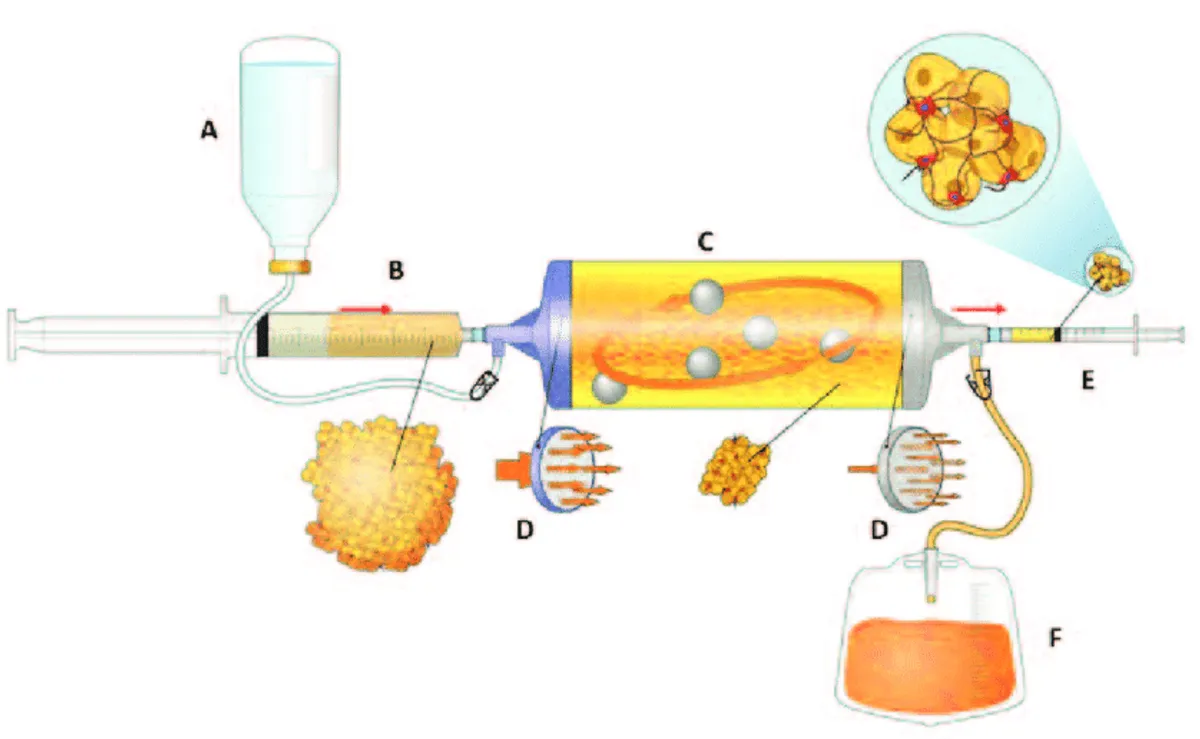
Fat tissue contains supportive cells and structural material that sit alongside small blood vessels. With microfragmented adipose tissue (MFAT), a small amount of fat is taken, usually from the belly or flank, and rinsed and broken into tiny clusters in a closed device. This keeps the tissue's natural structure while making it fine enough to pass through a needle.
We consider microfragmented adipose tissue (MFAT) for arthritis of the knee, hip, shoulder, and other joints, and for some chronic tendon problems. The processed tissue may act as a cushion and support a calmer joint environment. It does not rebuild cartilage, but it may reduce pain and help you stay active.
Dr. Gruner and Dr. Chen perform both the fat collection and the injection under local anesthetic, with ultrasound guiding placement. As with every orthobiologic, microfragmented adipose tissue (MFAT) is part of a larger plan built around strength training and smart activity choices.
Where we use Lipogems (microfragmented adipose tissue)
Watch: Lipogems (microfragmented adipose tissue) explained
More videos
The differences between microfragmented adipose tissue and bone marrow aspirate concentrate, and how each is used.Featuring Dr. Gruner
What happens during treatment
- 1.
Your physician confirms the diagnosis with an exam, ultrasound, and imaging, and reviews whether microfragmented adipose tissue (MFAT) is a good fit.
- 2.
The skin over the belly or flank is cleaned and numbed, and a small amount of fat is gently collected through a thin tube.
- 3.
The fat is rinsed and processed in a closed device to create small, uniform clusters.
- 4.
The joint or tendon is numbed, and the processed tissue is injected under live ultrasound guidance.
- 5.
A compression garment or dressing is placed at the collection site, and you go home the same day.
Who may be a good candidate
- Adults with moderate joint arthritis who have not had enough relief from exercise, weight management, and simpler injections.
- People who want to stay active and are not ready for, or are not candidates for, joint replacement.
- Some people with chronic tendon problems who have not improved with rehab or other injections.
- People with enough fat tissue for collection and who are comfortable with a same-day procedure under local anesthetic.
Recovery
The collection site is often bruised and sore for a week or so, and you may wear a compression garment for several days. The treated joint commonly feels full or sore at first. Most people return to light activity within days and progress to harder exercise gradually over the following weeks. Any benefit usually builds over time rather than right away.
Risks and limits
Expected effects include bruising, swelling, and soreness at the collection site and the injected joint. Less common risks include infection, bleeding, lumpiness or contour changes where fat was taken, and nerve irritation. Anti-inflammatory medicines and blood thinners need review before the procedure. Microfragmented adipose tissue (MFAT) is not suitable for people with active infection or active cancer. It does not rebuild cartilage, it is not a substitute for joint replacement in severe arthritis, and results vary.
What to expect at your visit
- 1.
We listen first
Your visit opens with a real conversation: how the problem started, what you have already tried, and the activity you want back.
- 2.
Exam and in-office ultrasound
A hands-on exam, then ultrasound at the exam table, often while you move, so your physician can see the tendon, joint, or nerve involved.
- 3.
A clear diagnosis and plan
You leave knowing what is wrong and what your options are, from strength-based rehab to procedures, and why we recommend each one.
- 4.
Treatment and follow-through
Most procedures happen here in the office. We coordinate with your physical therapist and check progress against the goals you set.
Rehab protocols
Dr. Gruner's week-by-week recovery guidelines. Your plan is individualized; follow these with your physician and physical therapist.
Clinical evidence
Published studies our physicians draw on. Results in studies do not predict any one person's outcome.
Questions about Lipogems (microfragmented adipose tissue)
- Is microfragmented adipose tissue (MFAT) the same as liposuction?
- The collection uses a similar technique, but the amount of fat taken is small and the goal is not cosmetic. Most people do not notice a change in body shape. The collected fat is processed and used only for the injection.
- How is microfragmented adipose tissue (MFAT) different from BMAC?
- Microfragmented adipose tissue (MFAT) comes from your fat tissue, while BMAC comes from your bone marrow. Both are your own tissue, prepared and injected in the same visit. Your physician will recommend one based on the joint, the severity of the problem, and your health history.
- Will microfragmented adipose tissue (MFAT) rebuild my joint?
- No. Microfragmented adipose tissue (MFAT) does not rebuild cartilage or reverse arthritis. The goal is to ease pain and improve function so you can keep moving and strengthening.