
About trigger finger
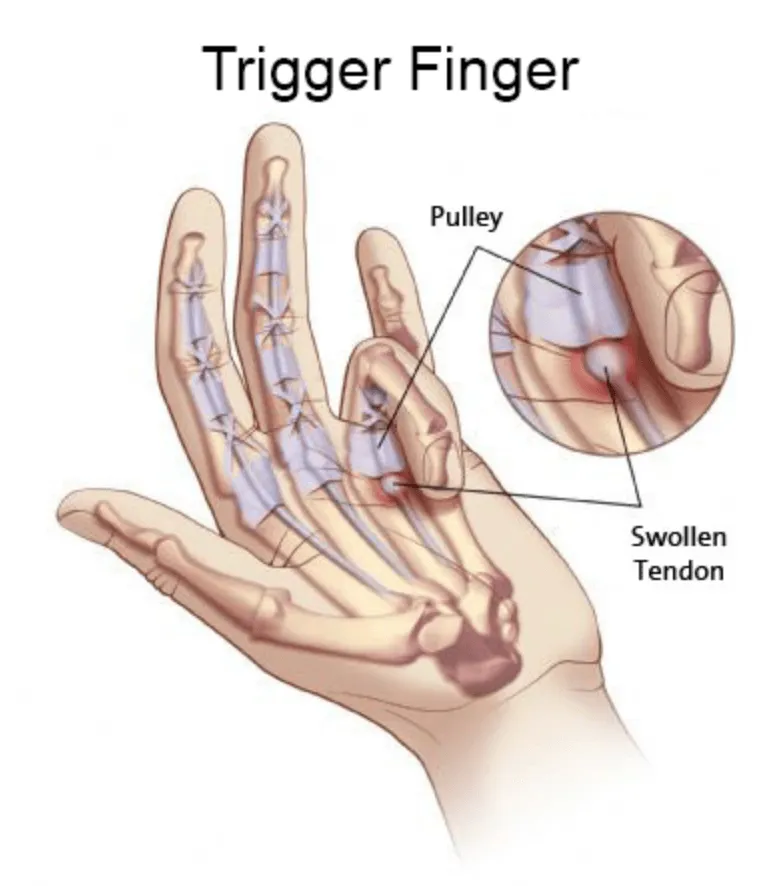
Each finger bends because tendons in the palm pull on it. Those tendons glide through a series of fibrous tunnels called pulleys, which keep them close to the bone. In trigger finger, the first pulley at the base of the finger thickens, or a nodule forms on the tendon, so the tendon no longer slides smoothly.
At first you may only feel a tender bump in the palm or some morning stiffness. As it progresses, the finger catches and then snaps straight, and in some cases it stays locked until you pull it free with the other hand. The thumb, ring finger, and middle finger are affected most often.
Common symptoms
- A catching, clicking, or snapping sensation when bending or straightening the finger
- A finger that locks in a bent position
- A tender lump in the palm at the base of the finger
- Stiffness that is worst in the morning
- Pain in the palm with gripping
Common causes and risk factors
- Repeated or forceful gripping at work, in sports, or with hobbies
- Diabetes, which raises the risk and can make it harder to treat
- Inflammatory arthritis, such as rheumatoid arthritis
- Having had carpal tunnel syndrome or trigger finger in another digit
How we diagnose it
Trigger finger is usually clear from the exam, where we feel for the nodule and watch the finger catch. Our physicians add ultrasound at the exam table to see the thickened pulley and tendon directly and to check for other causes of catching, such as a cyst or joint problem. Watching the tendon move on screen also helps us plan exactly where a treatment should go.
How Propel treats trigger finger
Early trigger finger often responds to rest from aggravating grips, a small splint, and gentle tendon gliding. An ultrasound-guided injection places anti-inflammatory medicine inside the tendon sheath, right where the catching happens. For many people that one step is enough.
When catching returns or the finger locks, our physicians can perform an ultrasound-guided trigger finger release in the office. A needle-sized instrument divides the tight pulley while the tendon and nearby nerves stay in view the whole time. Most people move the finger right away and return to normal hand use quickly, without stitches.
Watch: Trigger Finger explained
What to expect at your visit
- 1.
We listen first
Your visit opens with a real conversation: how the problem started, what you have already tried, and the activity you want back.
- 2.
Exam and in-office ultrasound
A hands-on exam, then ultrasound at the exam table, often while you move, so your physician can see the tendon, joint, or nerve involved.
- 3.
A clear diagnosis and plan
You leave knowing what is wrong and what your options are, from strength-based rehab to procedures, and why we recommend each one.
- 4.
Treatment and follow-through
Most procedures happen here in the office. We coordinate with your physical therapist and check progress against the goals you set.
Clinical evidence
Published studies our physicians draw on. Results in studies do not predict any one person's outcome.
Questions about trigger finger
- How many steroid injections can I have for trigger finger?
- Most physicians limit injections in the same finger, since repeated steroid can weaken tissue over time. If the first injection helps only briefly, a release is often a better next step than injecting again. We talk through the trade-offs with you at each stage.
- Is a needle release for trigger finger as effective as open surgery?
- Ultrasound-guided release divides the same pulley that open surgery does. Because the tendon and nerves are visible throughout, the release can be precise without a larger incision. We review whether you are a good fit based on your ultrasound findings.
- Can trigger finger come back in another finger?
- Yes. People who develop trigger finger in one digit, especially those with diabetes, are more likely to develop it in another. Each finger can be treated on its own as needed.